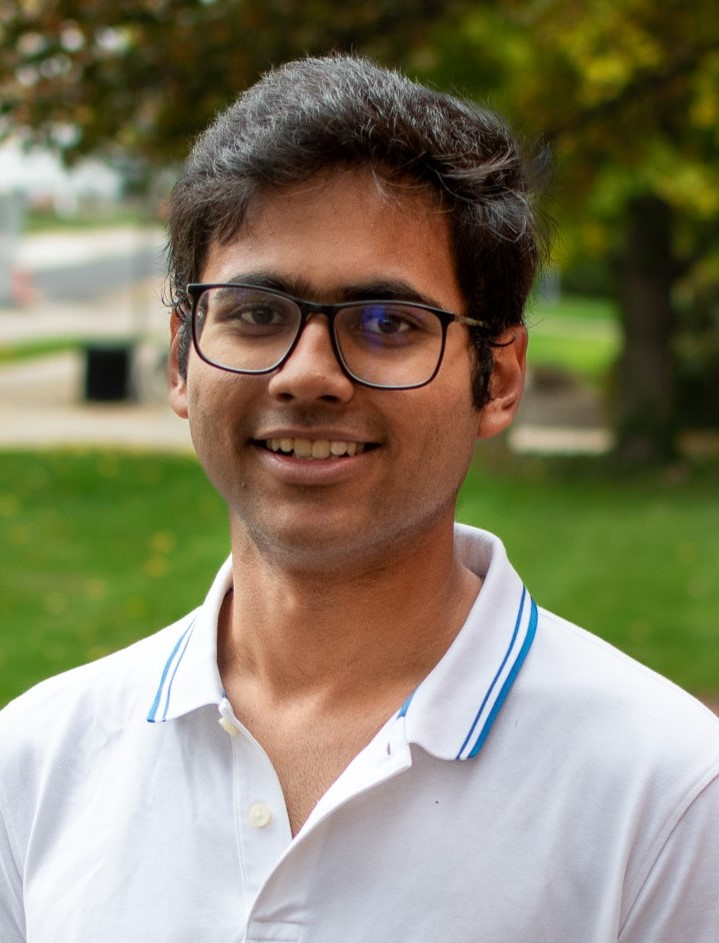
Dev Mehrotra
Intelligent hardware · AI & perception · ML infrastructure
I engineer intelligent systems from sensor to model.
I’m an ML and hardware engineer completing a PhD at Aarhus University. I build end-to-end systems that connect custom sensing hardware, computer vision, machine learning, and reliable data infrastructure—from automated imaging platforms to bioacoustic pest detection.
Selected engineering projects
Automated experimental platform
Integrated environmental control, continuous video capture, device orchestration, long-run experiment management, and timestamp-aligned metadata in a modular test platform.
View the systemScalable visual representation learning
Benchmarked DINOv2, diffusion, and VQ-VAE architectures on 1.5 million multi-channel images; improved classification AUROC by 18% and optimized 64-GPU training.
Read the projectBioacoustic detection system
Integrated contact-microphone acquisition with self-supervised feature learning and classification, reaching 96% precision on faint in-plant pest signals.
Read the projectCore engineering skills
Hardware & robotics
Build: custom experimental platforms, camera and illumination systems, environmental control, embedded acquisition, and bioacoustic devices.
Integrate: LiDAR, time-of-flight sensors, contact microphones, UR5, ROS, and Gazebo.
AI & perception
Develop: computer-vision, bioacoustic, and representation-learning pipelines.
Methods: PyTorch, DINOv2, transformers, diffusion models, VQ-VAE, OpenCV, NeRF, and self-supervised learning.
Software & infrastructure
Engineer: Python and C++ services, experiment-control software, structured datasets, metadata logging, and reproducible pipelines.
Scale: DeepSpeed ZeRO-3, distributed GPU training, Docker, and 64×A100 workloads.
How I work
I work across the full engineering stack: define the measurement problem, prototype and integrate the hardware, build the acquisition software, structure the data, train the models, and validate the complete system. That end-to-end perspective helps me find failures at the interfaces between hardware, software, and ML—where many real-world systems break down.
My PhD and research roles have given me experience owning ambiguous technical problems, rapidly learning across disciplines, and turning prototypes into dependable platforms. I’m interested in bringing that experience to industry teams building robotics, intelligent devices, computer-vision products, or applied ML systems.
Engineering results
- Computer-vision model benchmarking: trained and evaluated DINOv2 representations on 1.5 million multi-channel images, increasing gene-classification AUROC by 18% relative to an ImageNet-pretrained baseline.
- Distributed-training optimization: implemented DeepSpeed ZeRO-3 across 64 A100 GPUs, reducing epoch latency from 6.4 hours to 1.7 hours—a 3.8× throughput improvement—while lowering compute cost by 54%.
- Bioacoustic classification pipeline: integrated contact-microphone acquisition, signal preprocessing, self-supervised feature extraction, and classification to achieve 96% precision on in-plant pest detection; the validated system supported $350,000 in project funding.
- Extrinsic sensor calibration: automated calibration of VL53L3CX and VL6180X time-of-flight sensors with ROS, Gazebo, and UR5, validating sensor poses through 3D reconstruction with sub-2 mm residual error.
- Automated imaging and data ingestion: integrated camera control, standardized illumination, structured metadata, and dataset curation into a repeatable pipeline that produced 5,000+ curated images across species.
Let’s connect
Building a product where hardware meets AI?
I’m interested in ML engineering, computer vision, robotics, and intelligent-device opportunities where end-to-end systems thinking matters.